Battery-Operated Stacker: What It Is, How It Works, and What It Costs
TABLE OF CONTENTS
- How a Battery-Operated Stacker Works
- Types of Stackers: Which One Fits Your Warehouse
- Battery Stacker vs Forklift
- What Drives the Price
- The Bottom Line
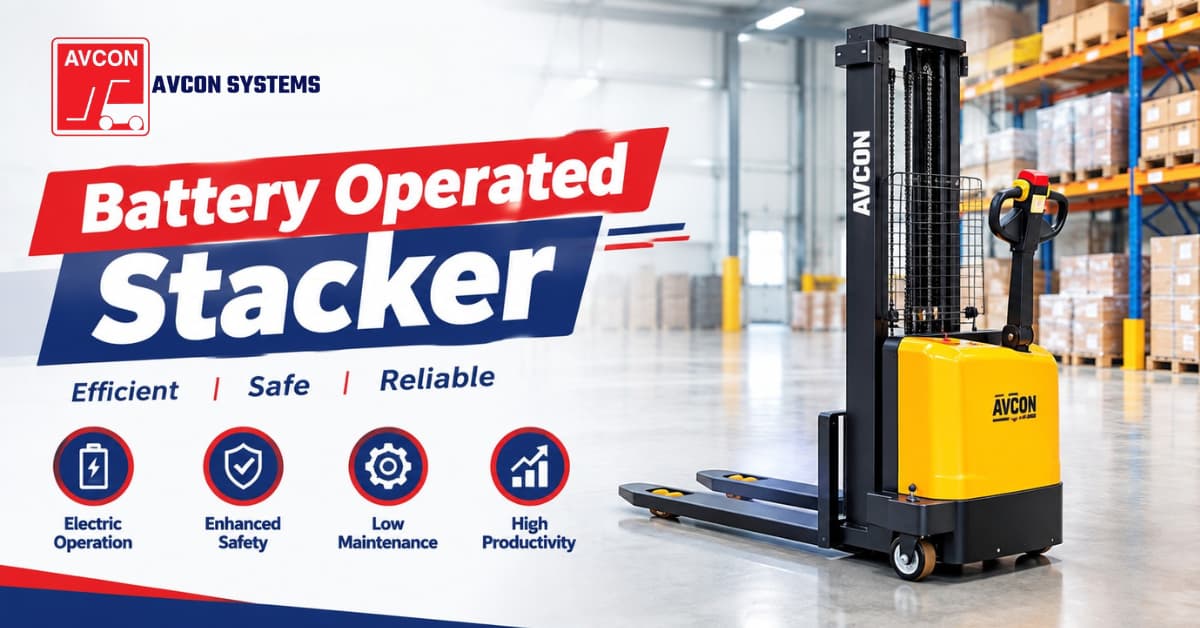
A battery-operated stacker lifts and stacks pallets using an electric hydraulic pump instead of manual pumping, cutting operator effort and letting one worker move loads that would otherwise need two people or a much larger forklift.
The Big Picture
- A battery-operated stacker uses an electric hydraulic pump to lift loads, removing the manual pumping needed on older hand stackers.
- Semi-electric models keep manual push/steer but power the lift; fully electric models power both lift and movement.
- Load capacity typically runs from 500 kg on compact models up to 2,000–2,500 kg on higher-capacity units.
- Price depends on capacity, lift height, battery type, and whether the unit is semi- or fully electric.
- Stackers are built for indoor warehouse aisles and lighter-to-medium loads; forklifts are built for heavier loads and outdoor or mixed-terrain use.
How a Battery-Operated Stacker Works
Lifting a pallet on a manual hydraulic stacker means physically pumping a lever until the forks reach the desired height. A battery-operated stacker replaces that pump action with an electric motor: the battery drives a hydraulic pump, the pump pressurizes a cylinder, and the cylinder raises the mast at the push of a button, regardless of load weight within the machine’s rated capacity.
Two systems determine how much of the process is automated. The lift system is electric on every battery stacker, semi-electric or fully electric — it’s the core feature that separates a “battery-operated” stacker from a fully manual one. The drive system is where the two configurations diverge: on a semi-electric unit, the operator still pushes and steers by hand; on a fully electric unit, a second battery-powered motor drives the wheels too, controlled through a tiller arm.
A deep-cycle industrial battery — commonly 12V, 24V, or 48V depending on the model — powers both systems and is typically recharged overnight.

Types of Stackers: Which One Fits Your Warehouse
Manual (hydraulic) stackers suit low-frequency use and lighter loads at the lowest cost, since both lift and movement are manual. Semi-electric stackers power the lift while the operator still pushes the unit — a common choice for warehouses with frequent lifting over short distances. Fully electric stackers power both lift and movement, built for higher throughput and longer travel between racks. Walkie reach stackers add a reach mechanism for narrow-aisle racking, and straddle stackers use straddle legs instead of a counterweight for open-bottom pallets and a tighter turning radius.
Battery Stacker vs Forklift
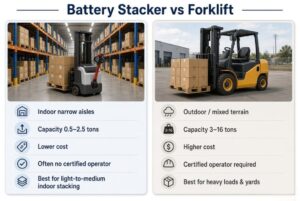
The most common comparison buyers search for isn’t between stacker types; it’s stacker versus forklift. Stackers typically top out around 2–2.5 tons of capacity and work in narrow indoor aisles, while forklifts commonly handle 3–16 tons and need wider clearance for yards, docks, and mixed outdoor terrain. Stackers carry a lower upfront and running cost, and many models don’t require a certified operator, though this varies by region. The practical rule: indoor pallet stacking under roughly 2.5 tons calls for a battery stacker; heavier or outdoor work calls for a forklift.
What Drives the Price
Buyers researching how much an electric stacker costs are usually pricing against five variables: load capacity, lift height and mast type, semi-electric versus fully electric configuration, battery chemistry and Ah rating, and brand build quality with warranty and local service availability.
Total cost of ownership matters more than sticker price: battery replacement cycles, warranty length, and how fast a manufacturer can get a service technician on-site typically outweigh a small difference in upfront price.
Conclusion
A battery-operated stacker isn’t a forklift replacement; it’s the right tool for a narrower, more common job: getting palletized loads on and off racks indoors without exhausting the operator or requiring certified heavy-equipment training. For most warehouses, the decision isn’t stacker versus forklift; it’s which stacker configuration matches the aisle width, lift height, and daily cycle count they actually run.
Buyers comparing options in India should weigh after-sales support as heavily as the spec sheet. Battery and hydraulic components need service access, and a manufacturer with local technicians and spare-parts stock will usually cost less over three years than a cheaper machine with no nearby support.
References
- AVCON — Battery Operated Fully Electric Stacker
- AVCON — Industries Served
- AVCON — Leading Material Handling Manufacturer
- AVCON — Material Handling Equipment: Types & Buying Guide
- AVCON — What Is Material Handling Equipment?
- Avcon Stackers: Best Material Handling Equipment
- Material Handling Equipment Manufacturers in Mumbai
- Top Material Handling Manufacturer for Your Needs
Relatable Blog link:
https://avconforklift.com/buyers-guide-battery-operated-stackers/
https://avconforklift.com/leading-material-handling-manufacturer/
https://avconforklift.com/equipment-for-material-handling-types-buying-guide/
https://avconforklift.com/material-handling-equipment-manufacturers/
https://avconforklift.com/what-is-material-handling-equipment/
https://avconforklift.com/material-handling-equipment-manufacturers-in-mumbai/
https://avconforklift.com/avcon-stackers-best-material-handling-equipment/