Material Handling Equipment Manufacturers: What Indian Plants Should Actually Ask Before Buying
Most equipment conversations in Indian plants start with a catalogue. They should start with three numbers: the weight being moved, the distance it travels, and the legal limit a worker is allowed to carry by hand.
Get those three right, and the right machine becomes fairly obvious. Skip them, and you end up buying what the salesman was trying to move that quarter.
What Material Handling Equipment Actually Does in a Working Plant
The term sounds broad because it is. But walk any active warehouse or factory floor, and you will see four distinct jobs getting done.
Something moves goods horizontally — trolleys, hand pallet trucks, rolling loads from one end of the shed to the other. Something lifts them vertically — stackers, scissor lifts, floor cranes, drum lifters, raising loads off the ground. Something bridges the height gap between the floor and a truck bed — dock ramps and levellers. And something holds the load while it waits for the next step in the sequence.
Material handling equipment covers all four. Most plants need at least two of them. Getting the wrong one for the job does not just slow things down — it puts people in positions they were never meant to be in.
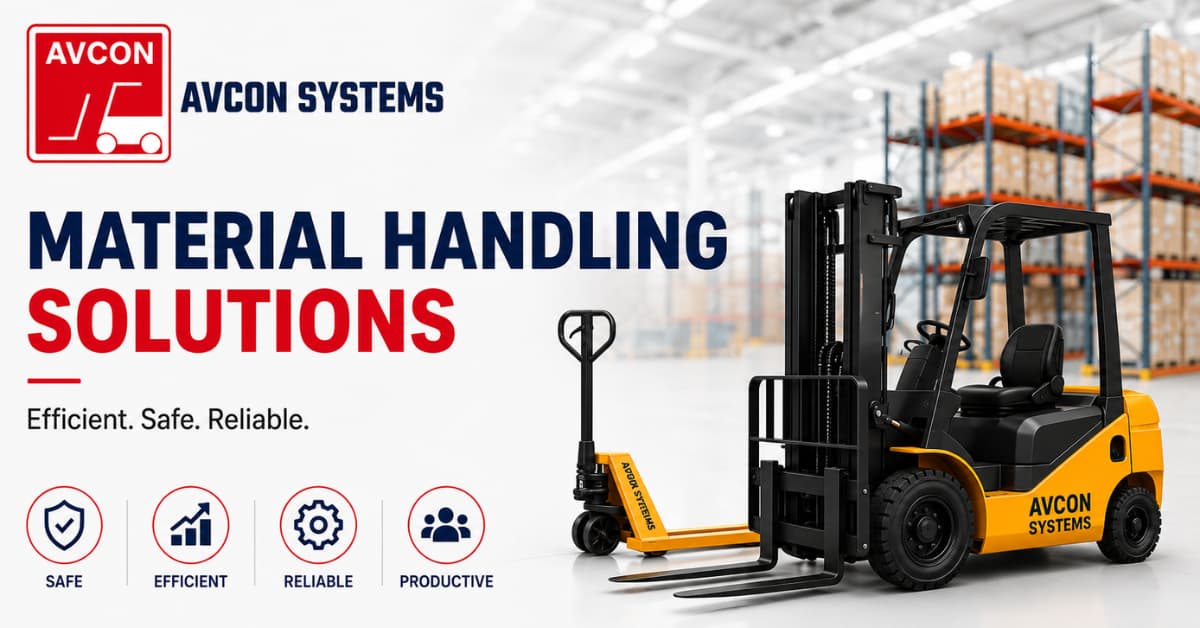
Avcon Systems has been building across all four categories since 1984, when Mr. V. S. Sawarkar started the company in Thane. Some of the equipment delivered in those early years is still running in plants whose current managers were not yet born when it arrived.
How Much Can a Worker Legally Lift by Hand in India?
Most supervisors do not know the answer to this. The ones who guess usually guess too high.
Rule 66 of the Maharashtra Factories Rules, 1963, sets these limits clearly:
|
Worker Category |
Maximum Permitted Weight |
|
Adult male |
55 kg |
|
Adult female |
30 kg |
|
Adolescent male |
30 kg |
|
Adolescent female |
20 kg |
| Male child |
16 kg |
| Female child |
13 kg |
There is a clause that regularly catches plants out: two workers lifting together are still held to the sum of their individual limits. Pairing up does not double the ceiling. It spreads the same ceiling across two people — and two spines.
The authority behind all of this is Section 34 of the Factories Act, 1948, which prohibits employing any person to lift a load likely to cause injury. The specific numbers are set state by state, so plants outside Maharashtra should check their own state’s schedule.
Is 55 kg actually a Safe Weight to lift?
Legal and safe are two different numbers. The gap between them is where most back injuries actually live.
The NIOSH Revised Lifting Equation — which OSHA directs employers to use, since OSHA has no lifting standard of its own — arrives at a recommended limit of 51 lb, roughly 23 kg. And that figure assumes ideal conditions: load held close to the body, no twisting, good grip, not repeated frequently. Break any one of those conditions, and the recommended weight drops below 23 kg.
So the law in Maharashtra permits 55 kg. The ergonomics research says 23, and usually less under real working conditions. Everything between those two numbers is a calculated bet on someone’s lower back.
The cost of losing that bet is documented. Musculoskeletal disorders account for around 30% of all workplace injuries that result in days away from work. Overexertion is the leading cause. The median case costs twelve working days per injury.
Twelve days per injury. Check the price of a trolley before deciding that number is someone else’s problem.
When Does a Material Shifting Trolley Make Sense?
When the goods are not on a pallet, the floor is flat, and the job is getting them from one point to another.
Drums. Gas cylinders. Caged components. Loose cartons. Tooling moved between workstations. None of these need to be lifted — they need to stop being carried. And carrying, not lifting, is what quietly accumulates across a shift until someone’s back gives out on a perfectly ordinary Tuesday for no obvious reason.
The trolley is also the cheapest solution on this page. If workers on the floor are still walking loads by hand, the trolley should come before anything else.
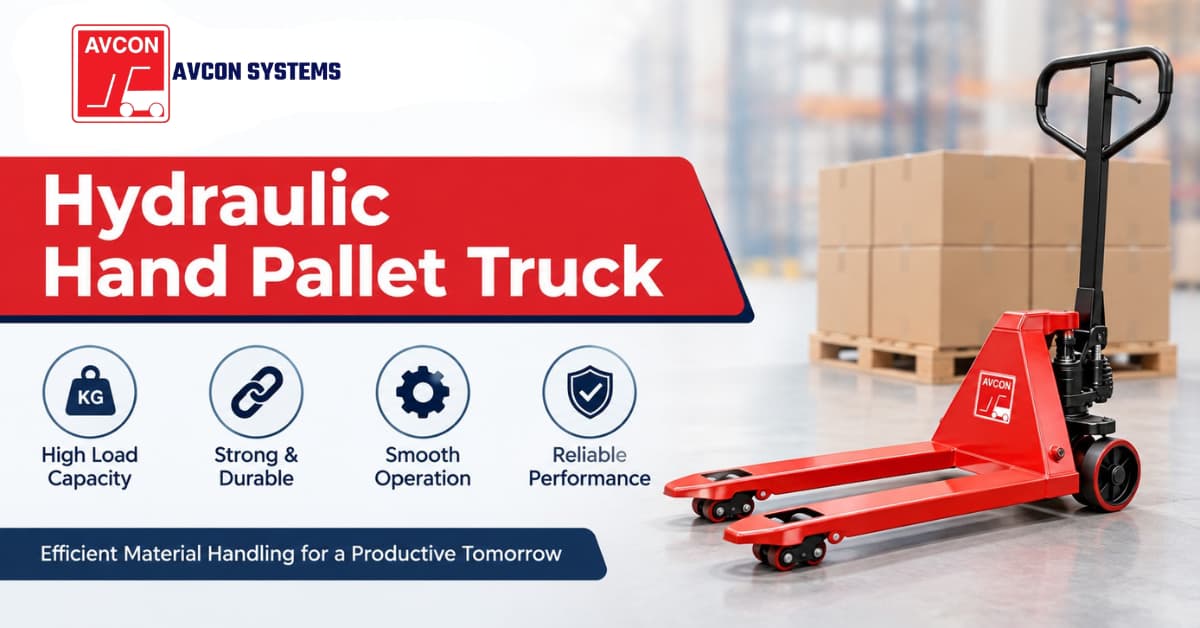
What to Check Before Buying a Hand Pallet Truck
Fork size is where most of the money gets wasted in this category.
Six pallet footprints are recognised under ISO 6780. The 1200 × 1000 mm dominates across Asia-Pacific. Europe standardises on the 1200 × 800 mm Euro pallet. Specify forks for the pallets actually arriving at the dock — not the ones a supplier mentioned switching to at some point. Get the size wrong and the forks either cannot enter the pallet at all, or they carry it half-supported. The second failure is worse, because it looks fine until it is not.
Beyond fork size, four things matter:
Capacity. Spec against the heaviest load the truck will ever carry. Not the average. The average is never the load that causes the incident.
Wheels. Polyurethane on smooth concrete. Nylon where the floor is rough, wet, or uneven.
The pump. This is where cheap trucks fail, and the failure is invisible at purchase. It shows up eighteen months in, on a day when the truck cannot be spared.
Material. Food processing, pharmaceutical lines, anything that gets hosed down regularly — stainless steel. SS 304 hand pallet trucks exist specifically for these environments.
Spare parts availability. A truck for which seal kits cannot be sourced has an effective expiry date, regardless of what the warranty says.
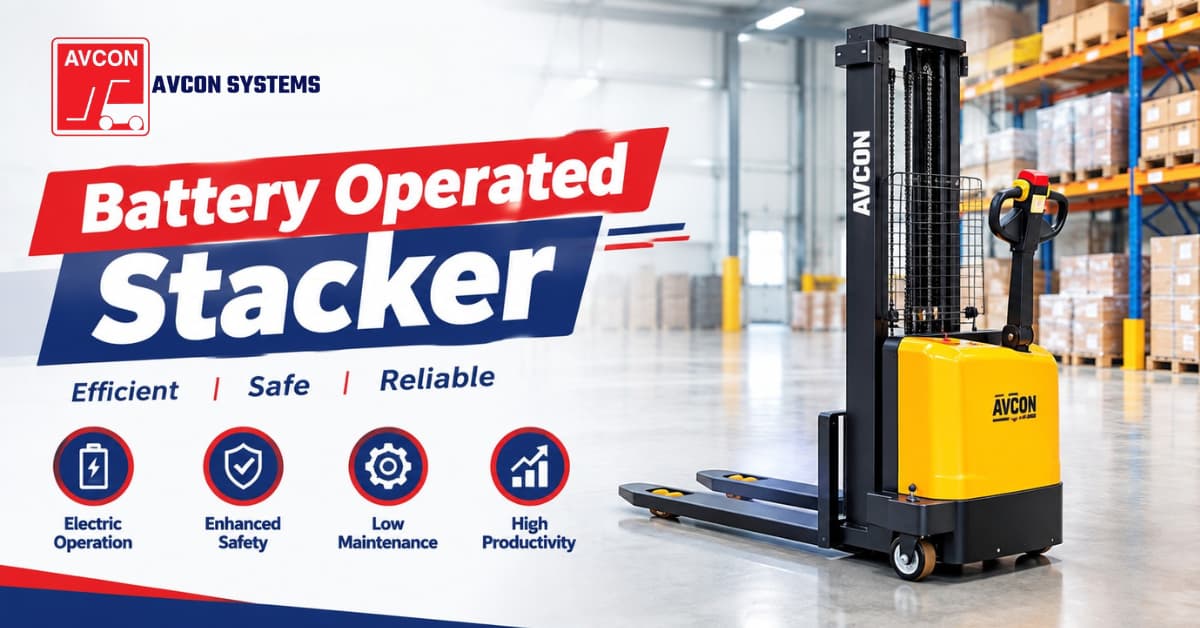
Do Stackers and Scissor Lifts Require Trained Operators in India?
Rule 64 of the Maharashtra Factories Rules is direct on this.
No person under 18 years of age may operate a lifting machine. No adult may operate one without being properly trained on that specific machine and made aware of the risks it carries. Before any lifting machine, chain, rope, or tackle goes into service for the first time, a competent person must test and examine it, issue a certificate specifying the safe working load, and that certificate must be available to any inspector who requests it. All examinations are recorded in Form 12.
Buying the stacker is the easy half. The compliance that comes with it is the other half, and it is not optional.
How Large Is India’s Material Handling Equipment Market?
The forecasts differ on the total but agree on the direction.
IMARC Group estimated the Indian material handling equipment market at USD 10.57 billion in 2024, projecting growth to USD 22.48 billion by 2033 — an annual compounding rate of roughly 8%. The growth is attributed to PLI-scheme manufacturing expansion, the continued rise of e-commerce logistics, and infrastructure investment. Grand View Research, using narrower market boundaries, put the figure at USD 5.4 billion in 2023, rising to USD 8.7 billion by 2030.
The gap in numbers reflects different definitions of what gets counted. The direction is not in dispute. Throughput demand is rising faster than floor space is being added, and that gap does not close with more square metres. It closes with equipment.
How to Actually Choose Between Material Handling Equipment Manufacturers
The useful comparison is not between catalogues. It is between which manufacturer asks better questions before quoting anything.
Did anyone visit the floor?
A quote written without walking the site is arithmetic built on assumptions. Aisle width, floor gradient, door clearances, available power supply, number of operating shifts — every one of these moves the specification. Skipping the site visit does not save time. It shifts the cost of getting it wrong onto the buyer.
Can they build off-catalogue?
Standard machines solve standard problems. Real plants have low doorways, irregular loads, and racking installed by people who left the company years ago. The question is whether the manufacturer can work around the constraint or only sell against it.
Is service coverage real?
One stacker down can idle an entire loading bay. The question is not whether a service network exists — it is how quickly a technician physically arrives on site.
Do they build for the specific operating environment?
Stainless steel for pharmaceutical and food lines. Flameproof configurations where the atmosphere requires it. Corrosion-resistant finishes where coastal or chemical humidity is a factor. A general-purpose machine in a specialised plant is a failure with a delay built in.
Will the manufacturer still be operating when the machine needs parts in a decade?
Equipment outlasts managers and job roles. Longevity is not a vanity metric for a manufacturer — it is the buyer’s spare parts guarantee.
Why Avcon Systems
Avcon has been building material handling equipment in Thane since 1984. The product range covers manual and powered trolleys for floor transportation, hydraulic hand pallet trucks including SS 304 stainless variants for washdown environments, manual and electric stackers, scissor lifts, hydraulic lifts, floor cranes, drum lifters, and dock ramps with levellers.
Emergency stops, safety interlocks, and overload protection are standard across the range. Custom configurations are available where the catalogue specification does not fit the application. AMC and service support run across India.
The claim Avcon makes is a narrow one: we inspect the floor before quoting the machine. Four decades of this work have established that the machine itself is rarely the difficult part. Understanding the floor, the load, and the conditions it has to survive in — that is what takes the time, and that is what the quote should reflect.
Book a free on-site inspection at avcon.co.in
Quick Reference: Common Questions
What is the safest way to move a heavy load in a plant? Remove the person from the carrying job. Trolley for loose goods on a flat floor. Hand pallet truck, once the goods are on a pallet. Stacker or scissor lift the moment the load needs to gain height. Manual carrying is a fallback — not a planned method.
What is the difference between a pallet truck and a stacker? A pallet truck raises a pallet just enough to move it — typically 80 to 200 mm off the ground. A stacker takes it up: into racking, onto a truck bed, or stacked on top of another pallet. If the load needs to gain height, a pallet truck is never the right machine.
What pallet size is standard in India? No size is legally mandated. The ISO 6780 footprint of 1200 × 1000 mm is the dominant standard across Asia-Pacific. If the incoming pallet specification is unknown, this is the one to specify forks for.
Who manufactures hand pallet trucks in India? Avcon Systems has been producing hydraulic hand pallet trucks in Thane since 1984, including SS 304 stainless variants for food and pharmaceutical production lines. Service is available across India.
What is the first piece of equipment a small plant should buy? Almost always a trolley. Overexertion from manual carrying is the leading cause of days-away-from-work injuries in Indian manufacturing, and the trolley is the lowest-cost machine that removes carrying from the job altogether.