Floor space in Indian manufacturing and warehousing facilities has always been a constraint. As operations scale, the instinct is to expand outward — more floor area, more aisles, more square footage. But there is a direction most facilities underuse entirely: upward. Vertical lift solutions have changed how material handling equipment manufacturers in India approach this problem, and the results show in productivity numbers that horizontal expansion alone cannot match.
The Core Problem Vertical Lifts Solve
Multi-floor facilities — manufacturing plants, warehouses, pharmaceutical units, food processing lines — deal with one consistent friction point: moving materials between levels. Ramps take up floor space. Manual stairway handling is slow and creates safety exposure. Standard goods elevators built to passenger-lift standards are expensive to install and maintain under factory conditions.
A vertical lift designed for material handling is a different category of equipment from a passenger or goods elevator installed to building standards. The platform carries drums, pallets, crates, and production components — not people. It sits within a defined floor opening, runs on demand throughout the shift, and feeds material directly into the next stage of the workflow without any manual transfer between the lift and the line.
Types of Vertical Lifts Used in Indian Facilities
Vertical Reciprocating Conveyors (VRCs) are the most widely deployed option across Indian manufacturing and warehousing. A VRC moves materials — pallets, crates, cartons, drums, trays — between floor levels on a reciprocating platform. Two-post and four-post configurations are available depending on load size and stability requirements.
Vertical Lift Modules (VLMs) take a different approach — instead of moving materials between floors, a VLM stores goods vertically within the unit itself and retrieves them automatically on demand. Rabatex Industries manufactures VLM-ASRS systems with extractor speeds up to 0.6 m/s, built in mild steel with flexible tray slots that adjust to material height.
Continuous Vertical Conveyors are built for production environments where material cannot wait. A batch-style platform that loads, rises, and returns introduces gaps into a line that was designed to move without stopping. A continuous system eliminates those gaps — materials enter at the bottom, travel up, and exit at the upper level without the machine pausing between cycles. For food and beverage lines, packaging operations, and high-volume assembly facilities, this distinction matters directly to throughput.
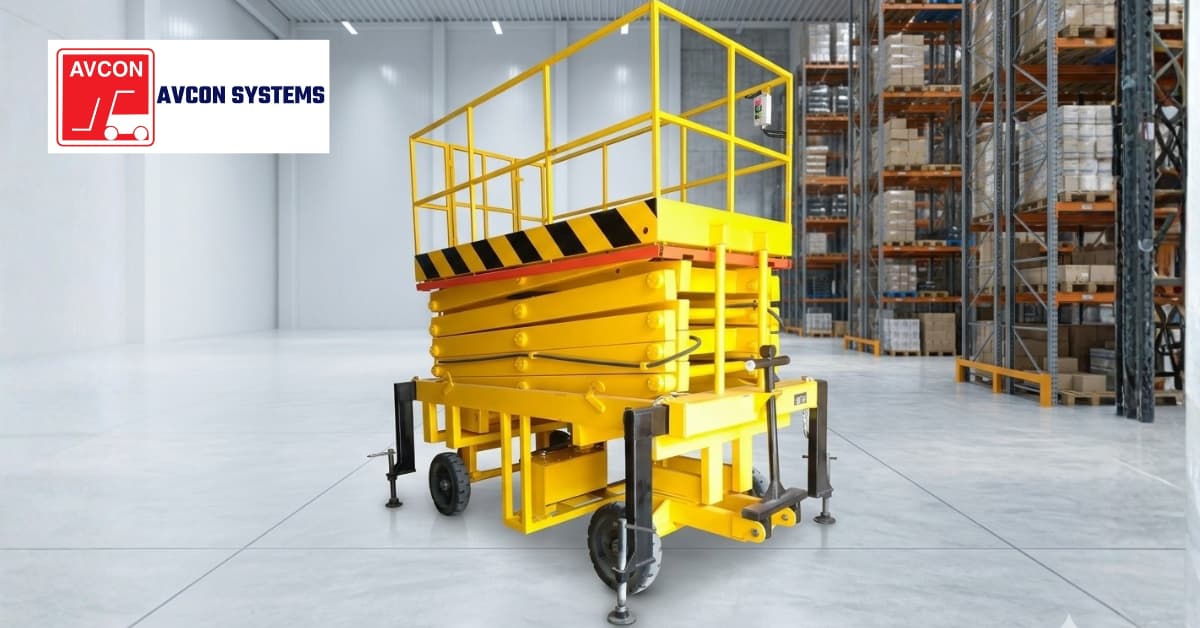
Scissor Lift Platforms address a different problem from floor-to-floor transfer. The material stays on the same level — what changes is its height relative to the operator or the next piece of equipment. A loading bay that receives trucks at varying heights, an assembly station where components need to sit at a consistent working position, a transfer point between two conveyors at different elevations — these are the situations scissor lifts are built for.
A scissor lift platform that rises to 1,200 mm on cycle one and 1,180 mm on cycle fifty is not a reliable piece of production equipment — it is a variable that the operator has to compensate for every time. Assembly work, loading bay operations, and conveyor-to-conveyor transfers are all built around fixed positions. The lift either holds that position reliably or it creates a problem at every handoff point throughout the shift.
Where Vertical Lifts Earn Their Keep Across Indian Industry
|
Industry |
What the Equipment Is Doing on That Floor |
| Manufacturing | Components reach the next assembly stage on a different floor without a manual handling step between them — line continuity stays intact |
| Warehousing & Distribution | Stock moves between levels on demand; no ramp, no forklift detour, no floor space lost to a permanent incline |
| Pharmaceuticals | Pharmaceutical batch materials cannot move through a facility on an ad-hoc basis. Every transfer between the processing floor and the packaging floor needs to be traceable — what moved, when it moved, and under what conditions. A VRC integrated into a documented handling procedure gives the quality team a transfer record at every point in the batch journey |
| Food & Beverage | A food production facility running a morning shift typically has raw ingredient deliveries arriving at ground level while the processing floor above is already running. The same lift that brought ingredients up at 6 AM is moving finished product down to the dispatch area by 2 PM — both directions, different load types, same equipment |
| E-commerce & Retail | An e-commerce fulfilment centre processing 3,000 orders per shift cannot move picked items to an upper-floor packing station by having operators carry them up a staircase. At that volume, the staircase becomes the bottleneck within the first hour. A vertical lift between the picking floor and packing area removes that constraint entirely |
| Automotive | Component transfer between assembly stages across floor levels without line interruption |
Key Specifications to Evaluate Before Buying
Load capacity — The range across commercially available VRCs in India runs from 500 kg for light carton transfer up to 5,000 kg for heavy industrial pallet movement. The figure to spec against is the heaviest single load the system will ever carry, including the pallet, packaging, and product together. A system sized to its average load will hit its ceiling regularly in practice.
Platform dimensions — Must accommodate your largest pallet or material footprint, including any overhang. Confirm against your actual material dimensions, not a standard pallet assumption.
Lifting height — The lifting height figure on a specification sheet is not the same as the usable travel distance in your facility. Mezzanine deck thickness, structural beams, sprinkler pipework, and ductwork running across the shaft path all reduce the available clearance. The only way to get this number right is to measure the actual installation space — not to work from floor-to-floor height on a building drawing.
Cycle speed — Critical for production-line integration, where throughput depends on transfer rate. A receiving dock and a continuous production line have very different cycle speed requirements from the same equipment category.
Control system — Basic push-button operation suits standalone warehouse applications. Facilities running automated workflows or WMS-integrated picking operations need PLC-compatible controls specified from the outset.
Safety interlocks — Floor-level gates, overload protection, and emergency stop systems are mandatory under Indian factory safety regulations and non-negotiable in any installation.
Why Sourcing from Indian Manufacturers Makes Operational Sense
Custom fabrication from a Pune or Ahmedabad manufacturer works differently from placing an import order. When the platform dimensions need to change because the floor opening was remeasured and the original spec was off, that revision reaches the fabrication team the same day and gets incorporated without a shipping delay attached to it. Flameproof enclosures for paint or chemical facilities, modified lifting heights to accommodate an unexpected beam — these changes move through a domestic manufacturer’s production process in days, not weeks. An imported equivalent with the same revision attached to it sits in a different time zone, waiting for a reply.
A vertical lift failure between two production floors does not stay contained to the lift. The floor above stops receiving materials. The floor below stops clearing them. Within an hour, both sides of the lift are backed up. A manufacturer with a regional service office in Pune, Ahmedabad, or Chennai can have a technician at the site within hours under most circumstances. That is not a minor convenience — it is the difference between a two-hour mechanical fix and a lost shift.
Cost structures are also more competitive. Indian-manufactured VRCs and vertical lift platforms are priced to suit the capital expenditure realities of mid-size Indian manufacturing operations — without the import duties, shipping lead times, and foreign currency exposure that come with overseas-sourced equipment.
Conclusion
India’s material handling equipment manufacturing sector — particularly across Pune, Ahmedabad, and Mumbai — now produces vertical lift solutions that hold their own on engineering quality, customisation capability, and after-sales response. For any facility where multi-floor material movement is part of daily operations, the right vertical lift is not a capital expenditure that recovers slowly. It shows its value in the first week it replaces what your team was doing by hand.