In most warehouses, there is a weighing station bolted to one corner of the floor. It made sense when the operation was set up. Nobody has questioned it since. But every time a worker routes a pallet through that station before delivering it — which happens all day, every day — the operation is doing more physical work than the job actually requires. The load goes to the scale, then to the destination, when it could have gone straight to the destination with the weight already recorded.
Two hundred pallet movements per day. Ninety seconds were added to each one because of the weighing detour. That comes to five hours of floor labour spent moving loads to a station and back, every single day, in a facility where that time could be spent on something that actually moves the operation forward.
A hand pallet truck with a built-in weighing scale means the worker never has to choose between moving the load and weighing it. Both happen at the same moment — forks under the pallet, handle pumped, weight on the display, load on its way. The fixed weighing station becomes redundant not because it was replaced, but because the need for it was removed.
The Equipment Itself — How It Is Built and What It Does
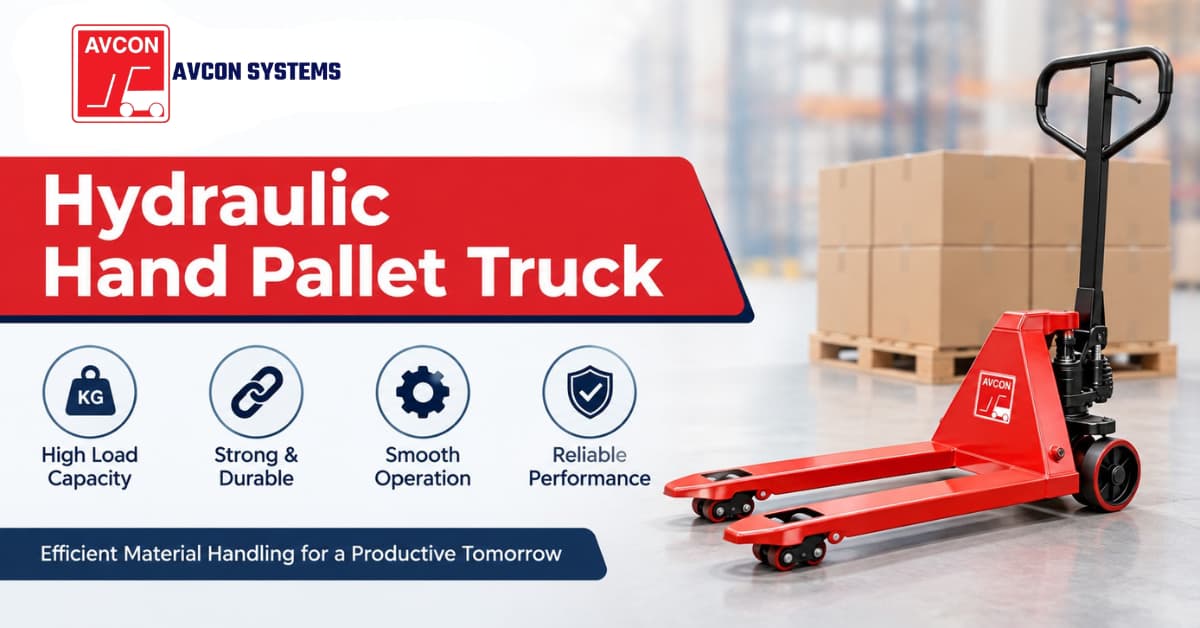
Walk into any warehouse, and you will find at least one hand pallet truck within thirty seconds. Most facilities run several. The equipment goes by different names in different industries — hand pallet jack, hydraulic pallet truck, pallet trolley, hand pallet mover — but the mechanics are identical regardless of what it says on the order form. You work the handle, the hydraulic system raises the forks, and the load travels with you. It is unglamorous, heavily used, and genuinely difficult to replace with anything simpler.
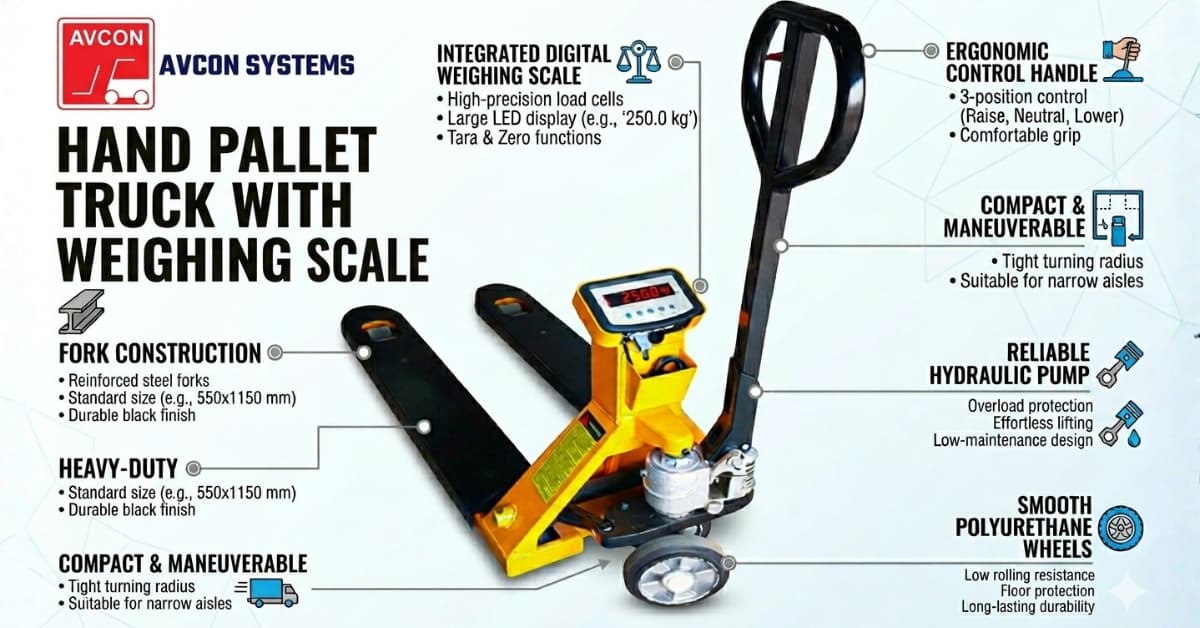
Inside the fork body of a weighing scale model, four load cells sit embedded in the steel. They are connected to a small digital display on the handle. When the forklift lifts the pallet, those cells measure the load, and the number shows up on the screen immediately. The truck itself feels and operates exactly like a standard unit — the only visible difference is the display.
The tare function is what makes the reading genuinely useful in practice. Press it before the lift, and the system subtracts the pallet’s dead weight automatically. What stays on the display is the net weight of the product — the number that matters for dispatch records, freight billing, and compliance documentation.
How It Works on the Floor
There is no meaningful learning curve for anyone already familiar with a standard pallet jack. The process is straightforward from the first shift.
Position the forks under the pallet. Press the tare button to zero out the empty pallet weight. Pump the handle to raise the load — a few centimetres of clearance is all the load cells need to produce an accurate reading. The net product weight shows on the display. Move the load to its destination as normal.
On quality models, accuracy holds at ±0.2% of full scale. For a 2,000 kg capacity truck, that is a working margin of ±4 kg — a standard that meets the requirements for freight billing, warehouse inventory records, and most regulatory compliance documentation without any additional verification step.
Some models also carry a summing function, which lets the operator accumulate weight totals across multiple pallets during a single shift. This is practical for progressive truck loading, batch dispatch operations, and supplier intake processes where a running total is part of the daily workflow.
Technical Specifications Worth Understanding
Load Capacity — The 2,000 kg standard covers most general warehousing work without issue. Where the decision becomes more specific is when loads are consistently dense, bulky, or stacked in ways that push toward that ceiling. In those situations, stepping to a 2,500 kg or 3-ton model is the practical choice — not because a 2,000 kg unit will fail immediately, but because equipment that regularly operates near its rated limit wears differently than equipment with headroom to spare.
Fork Dimensions — In India, the two sizes encountered most often are 1150×550 mm and 1220×700 mm. The fork outer spread must match the pallet being lifted. This sounds straightforward, but it is the specification buyers most commonly overlook until the equipment arrives on site. Measure the pallets before the order is placed.
Display Quality — A 2-inch LED display holds up across varying lighting conditions — from dim storage aisles to bright sunlit loading docks. Several current models feature rotatable screens. That is worth specifying if operators regularly pull the truck in reverse, since the display stays oriented correctly without requiring any positional adjustment.
Battery — The typical specification is 6V with a capacity between 4Ah and 6Ah. For most single-shift operations, that is adequate. The question to ask before buying is how many weighing cycles the operation actually runs per shift — not just how many pallets move in a day. A high-frequency picking environment and a lower-volume receiving dock place very different demands on the same battery rating.
Lifting Height — Standard range runs from 85 mm lowered to approximately 200 mm raised. Flat floor operations present no issue. Dock levellers, internal ramps, or uneven concrete — confirm the lowered fork clearance against actual site conditions before assuming compatibility.
Tare and Auto-Zero Functions — Confirm these are present on any model under evaluation. In any volume operation, they are not optional additions. They are what make accurate net weight readings possible under real working conditions throughout the shift.
Why Operations Are Making the Switch
Time recovery is the argument that lands first, and the arithmetic is not complicated. A warehouse handling 200 pallet movements per shift, recovering 90 seconds per movement by cutting out the weighing station detour, gets back five hours of productive labour time in a single day. Over a working month, that figure is worth presenting to any operations or finance team directly.
Equipment consolidation follows naturally. A floor scale and a pallet truck sitting on the warehouse floor are not just two pieces of equipment — they are two maintenance schedules, two service call histories, and two independent failure points. When one goes down, part of the workflow stops. A weighing scale pallet truck folds both into a single asset, and for most operations, the combined acquisition cost comes in lower than purchasing both separately at a comparable quality level.
Inventory accuracy improves when weight data is captured at the point of movement by the operator handling the load, rather than at a fixed station, where the load may or may not reach under consistent conditions. Discrepancies in stock records and dispatch documentation frequently trace back to the gap between where the measurement happened and where the handling decision was made. Closing that gap tightens both.
Regulatory compliance is the deciding factor in several sectors. Pharmaceutical, food processing, and freight operations carry weight documentation requirements that are not discretionary. When weighing is built into the transport action rather than treated as a separate workflow step, compliance records are produced as a byproduct of normal operations — not as an administrative task bolted onto the end of an already busy process.
Overload prevention is a safety benefit that tends to be underemphasised in equipment discussions. When a weight reading is visible throughout the lift and transport cycle, operators are aware in real time of how close a load is to the truck’s rated capacity. This directly reduces the likelihood of undetected overloading — one of the more common causes of hydraulic failure and workplace incidents in high-volume environments.
Sectors That Depend on This Equipment
| Sector | How It Gets Used |
| Warehousing & Distribution | Live weight capture during pick-and-pack and outbound dispatch |
| Manufacturing | Raw material intake verification and finished goods dispatch control |
| Retail & FMCG | Receiving accuracy and weight validation during stock rotation |
| Food & Beverage | Ingredient-level control during floor-level transport and batch preparation |
| Pharmaceuticals | Batch weighing with compliance documentation at the point of handling |
| Logistics & Freight | Accurate weight-based billing and carrier regulation adherence |
| Cold Storage | On-floor weighing without a separate temperature-controlled scale area |
Standard Pallet Truck vs. Weighing Scale Pallet Truck
| Feature | Standard Hand Pallet Jack | Weighing Scale Pallet Truck |
| Moves loads | Yes | Yes |
| Weighs loads during transport | No | Yes |
| Tare / net weight function | No | Yes |
| Requires separate floor scale | Yes | No |
| Piece counting | No | Available on select models |
| Upfront unit cost | Lower | Moderate to higher |
| Total cost across both assets | Higher — two assets | Lower — one consolidated asset |
| Compliance documentation | Limited | Yes, on calibratable models |
| Operator adjustment required | Minimal | Minimal — near-identical operation |
What Is Currently Available in India
India’s industrial equipment market now covers a practical range of weighing scale pallet trucks across capacity levels and price points.
Avcon Systems HT 2.5 Ton — industrial-grade mild steel construction, 205 mm maximum lift height, ergonomic foot pedals. Operators running extended shifts tend to notice the pedal design after a few hours of continuous use — it is a small detail that makes a genuine difference over a full working day.
Battery Operated and Electric Variants
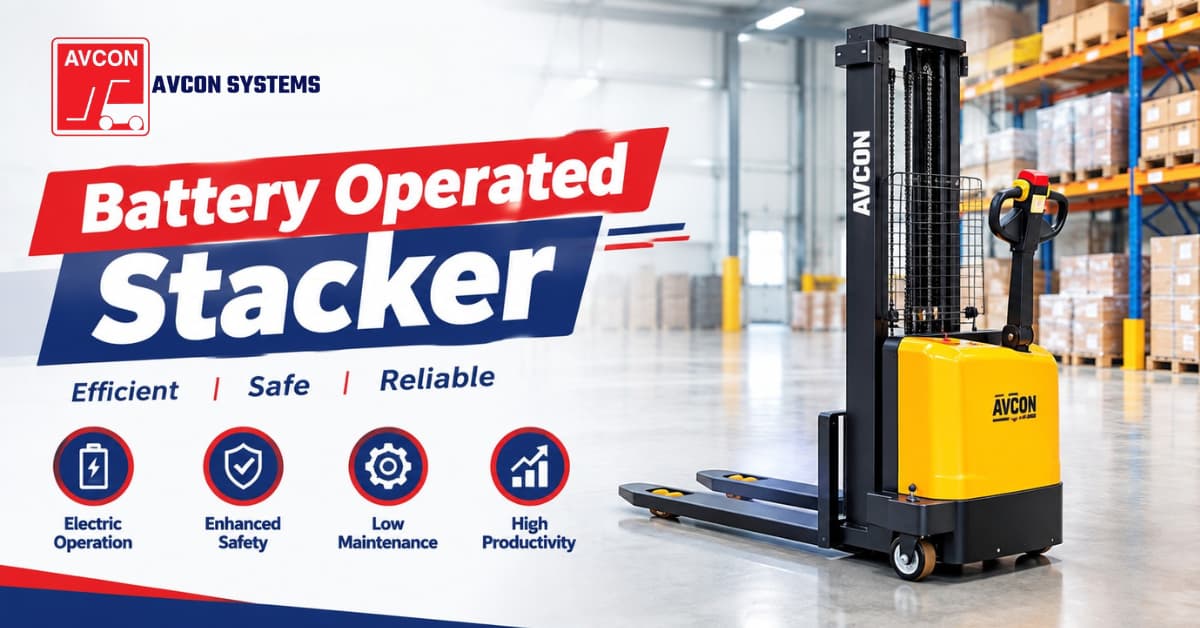
For operations running high cycle volumes or extended shifts, battery-operated pallet trucks and semi-electric pallet jacks with integrated weighing remove the physical effort from the equation entirely. The operator guides the load; the drive system handles the lifting and propulsion. Over eight to ten hours, that difference in physical demand is not trivial — and it shows in output quality toward the end of a shift.
With IoT-connected models, weight data reaches the warehouse management system at the moment the load is lifted — not at the end of the shift when someone keys it in from a handwritten sheet. Transcription errors disappear because there is no transcription. The record is created by the act of handling the load, not by a separate data entry step that depends on whoever happens to be holding the clipboard.
Cold storage aisles, clean rooms, and tight racking configurations have one thing in common — a full-size electric forklift does not fit comfortably, and in some cases does not fit at all. Compact electric pallet trucks with built-in weighing fill that gap directly. They handle the movement, the weighing, and the data capture in spaces where larger equipment simply cannot operate.
Four Decisions to Make Before Buying
- What is the heaviest load your operation actually moves — not on average, but at its worst?
That number is what should drive the capacity decision. Equipment consistently sized to its ceiling wears faster and behaves differently under operational stress than equipment with working headroom built in. - What are your actual pallet dimensions?
Confirm fork spread and length against pallets on your floor — not against what a supplier assumes is standard. This is the specification most commonly confirmed too late, after the equipment has already arrived on site. - Does your sector require formal, certified weight documentation?
If it does, request the ISO calibration certificate before the order is confirmed — not after delivery. Confirm the recalibration frequency requirements for your specific regulatory environment at the same time. - How many weighing cycles does your operation run per shift?
Manual pumping through sixty-plus weigh-and-move cycles per shift is a different physical demand than occasional use. By hour seven or eight, it shows — in how carefully operators handle loads, in movement speed, and eventually in injury rates and absence records. Battery-operated models remove that variable from the equation entirely.
Maintenance: What the Equipment Actually Needs
Hydraulic system — check weekly for oil seeping around the pump cylinder, the forks, or the lowering valve. A small weep caught early is a top-up job that takes five minutes. The same weep left for two months becomes a hydraulic rebuild that takes the truck off the floor for days. A weekly two-minute inspection is the entire difference between those two outcomes.
Battery — plug the unit in at the end of every shift, before the battery gets too empty, not after. Batteries that are regularly run to zero lose usable capacity faster than those kept in a healthy charge range. The difference shows up clearly when you compare battery replacement frequency between sites that follow this habit and those that do not.
Scale calibration — load cells drift after impact. A hard knock against racking, a dropped load, a collision at speed — none of these may leave visible damage, but the calibration can shift without any external sign. Schedule periodic recalibration and run an immediate check after any significant impact event. Every weight reading the truck produces afterward depends on that calibration being accurate.
Fork surfaces — in environments with product residue, dust, or loose particulate, debris sitting on the fork surface registers as part of the load during a weigh cycle. A clean fork before the first lift of the shift prevents this from compounding across the day and introducing cumulative error into dispatch and inventory records.
Storage — bring the unit indoors when it is not in active use. Load cell electronics and display components handle a standard working industrial environment without difficulty. Regular overnight exposure to moisture — particularly in humid coastal regions like Mumbai, Chennai, or Kochi — is a different matter entirely. Indoor storage costs nothing and consistently adds months to the usable service life of the electronics.
Conclusion
Most warehouse managers are not looking for equipment that reorganises the floor. They are looking for things that make what already works, work better. A weighing scale pallet truck fits that description precisely. The team keeps doing the same job they have always done — moving loads, recording weights, and dispatching product. The only difference is that two of those steps now happen simultaneously instead of separately. No retraining, no process documentation, no adjustment period. The improvement is built into the equipment itself.