Why Aerospace Industries Choose AVCON Floor Cranes
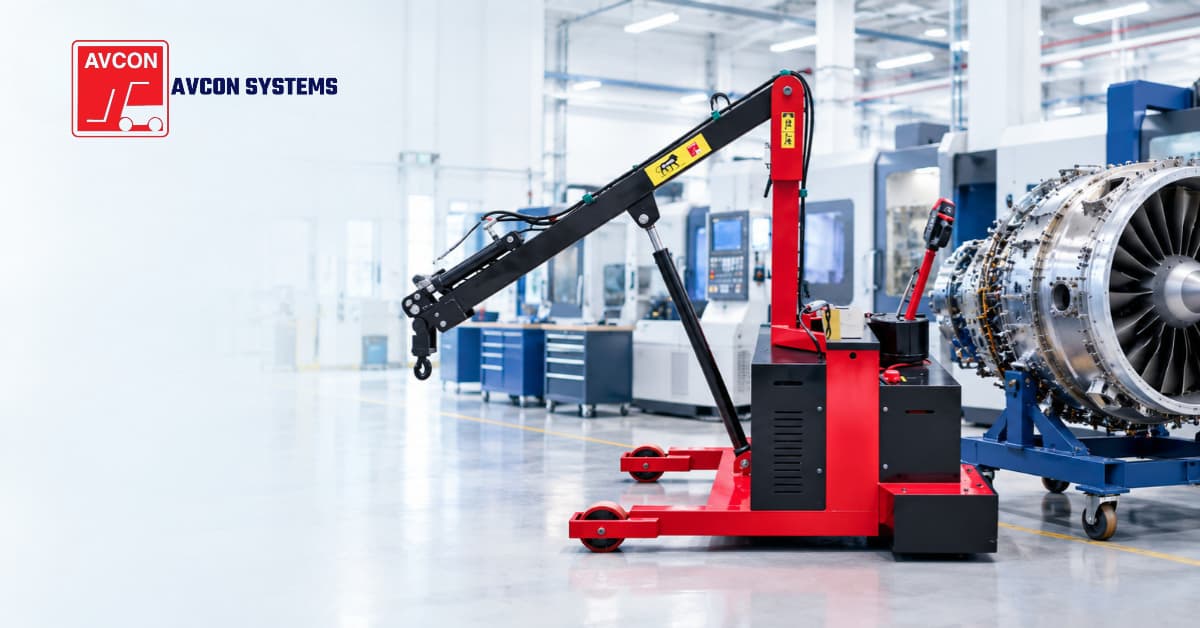
Aerospace manufacturers choose AVCON floor cranes because the crane is built around the process rather than picked from a catalogue. A custom battery-operated crane gives aircraft engine components smooth, jerk-free lifting. It runs with zero emissions in clean production areas and fits aisles that standard cranes can’t use. One operator can run it.
Key takeaways
- Aerospace parts are costly, finely machined, and easy to damage, so how a lift starts and stops matters as much as its capacity.
- General-purpose floor cranes are built for workshops and warehouses. Precision shop floors need something different.
- For one of the biggest producers of aviation engine parts in India, AVCON constructed a unique battery-powered floor crane. It reduces component movement time by 20% compared to the previous manual method.
- The same engineering approach applies to any plant that handles high-value, delicate, or awkward loads.
A battery-operated stacker lifts and stacks pallets using an electric hydraulic pump instead of manual pumping, cutting operator effort and letting one worker move loads that would otherwise need two people or a much larger forklift.
Why aerospace shop floors are hard on standard lifting equipment
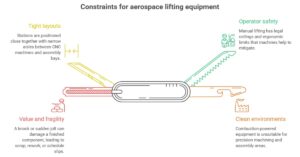
Aircraft engine components pass through machining, inspection, and assembly. At each step, they are lifted, moved, and set down again. Four constraints decide what equipment can work in that flow:
- Value and fragility. A knock or sudden jolt can damage a finished component. The cost is scrap or rework, and sometimes a schedule slip, not just a repair bill.
- Clean environments. Combustion-powered equipment doesn’t belong beside precision machining and assembly.
- Tight layouts. Stations sit close together, with CNC machines and assembly bays on both sides of narrow aisles.
- Operator safety. Lifting by hand has real limits. Our guide to material handling equipment manufacturers covers the legal manual-lifting ceilings under the Maharashtra Factories Rules. It also explains why ergonomic limits sit well below them. Every lift moved from hands to a machine lowers that risk.
The brief: what the customer needed
A specialized battery-powered floor crane was required by one of the biggest makers of aircraft engine components in India. Every day, it had to operate inside a precise process without sacrificing cleanliness or safety. The customer’s requirements were:
- Handle high-value engine components without damaging them
- Work efficiently in narrow production aisles
- Lift and lower smoothly, with no jerks
- Run without emissions in a clean indoor space
- Reduce physical strain on operators and keep them safe
- Adapt to the current production line without interfering with it
Where standard floor cranes fall short
Floor cranes are valuable because they are compact and easy to move through gangways and between machines. A general-purpose model is still designed for general-purpose work. In this case, the gaps were specific:
|
Requirement |
Typical general-purpose crane | What this job needed |
|
Floor space |
Takes up room the facility can’t spare | Compact footprint for narrow aisles |
| Lifting action | Sudden or jerky movement possible |
Smooth hydraulic lift with controlled lowering |
|
Power |
May rely on combustion engines | Electric battery drive, zero emissions |
| Operator effort | Heavy manual positioning |
Single-operator control with less physical effort |
|
Fit |
Fixed catalogue dimensions |
Boom, height and load set to the application |
| Mobility | Hard to manoeuvre in confined areas |
Easy movement around machines and assembly bays |
How AVCON engineered the crane
AVCON didn’t start from a product. It started from the customer’s workflow. Every dimension, movement, and feature came from studying how the plant actually works. The end product is a fully customized battery-powered floor crane that is small, well-designed, and easy for one person to operate.
Electric battery drive. The crane runs clean and quiet with zero emissions. Both properties suit aerospace facilities.
Smooth, controlled lifting. Shock loads are applied to a heavy component and its fittings when it accelerates upward or stops abruptly. Hydraulic lifting with controlled lowering keeps that acceleration gentle. This is the feature that most directly protects the component.
Compact footprint. The crane is built to fit in small areas. It moves around CNC machines and assembly bays without blocking the aisle.
Customised boom geometry. For this application, the load arrangement, lifting height, and jib length were determined. Engine components are rarely compact, so the boom can’t be generic.
Safety built around the operator. AVCON’s case study documentation lists an emergency stop, parking brakes, overload protection, a warning beacon, and an ergonomic tiller control. Every lift should feel controlled.
Single-operator efficiency. One person can run it comfortably. This lessens effort without slowing down the task.
The earlier write-up of this project also describes heavy-duty mild steel construction for durability and stability. You can read it in the original battery-operated floor crane case study. The full project summary is on our aerospace industry page.
The results
- Faster material movement. Moving parts between machining, inspection, and assembly stations took 20% less time than the previous manual procedure. That is roughly an 80% reduction.
- Better component protection. The possibility of unintentional damage to expensive engine components is reduced by controlled lifting.
- Safer workplace. People on the floor have better ergonomics and less manual handling.
- Lower environmental impact. Battery power reduces operating and maintenance expenses and produces no emissions.
- More efficient use of space. Floor space was made available for other aspects of the production process by the compact design.
Why battery-electric suits aerospace production
Electric drive suits aerospace for reasons beyond emissions. A battery-powered crane has no exhaust or fuel to manage. It is quieter, so operators can communicate and concentrate. It generally needs less maintenance than fuel-based alternatives, a point our equipment for material handling buying guide makes for indoor operations. It also keeps clean and controlled areas clean. If you’re still working out which category of equipment fits, that guide explains how transport, vertical lifting and positioning equipment divide the work.
Do you need a custom crane or a standard one?
Standard models handle many jobs. Consider a custom build if several of these are true:
- The load is high-value, fragile or awkwardly shaped.
- The aisles are narrower than a standard chassis allows.
- Emissions, noise or cleanliness rules limit your options.
- The load needs a specific jib reach or lift height.
- A single operator must handle the lift unaided.
- The crane has to fit into a live production line without redesigning it.
Whichever you choose, ask the manufacturer whether someone will visit the floor before quoting. Aisle width, gradients, door clearances, power supply and shift pattern all change the specification. We cover this in more detail in our guide to choosing between material handling equipment manufacturers.
AVCON’s standard floor crane range
If your job fits a standard machine, these are the starting points. Capacities and heights below come from our floor crane manufacturer guide:
- Semi-Electric Floor Crane: manually propelled, 1,000 to 1,500 kg, lift height up to 3,000 mm.
- Compact Fully Electric Floor Crane: for tight spaces, up to 500 kg, lift height up to 3,000 mm.
- Counter Balanced Fully Electric Crane: stays grounded with the boom fully extended, up to 1,500 kg, lift height up to 3,000 mm.
- Wide Chassis Fully Electric Floor Crane: the biggest in the range, up to 1,500 kg, lift height up to 4,500 mm, with better stability.
See all models on the floor cranes category page.
Supporting equipment for the same floor
A floor crane rarely works alone. Hygiene-sensitive production areas often pair it with stainless steel equipment. See our guide to AVCON stackers for SS 304 electric stackers and counterbalance stackers made for tight aisles. For a view across the whole product line, read how we approach material handling manufacturing.
Built and supported from Thane
AVCON has been solving material handling problems for Indian manufacturers since 1984, when it was founded in Thane under Mr. V.S. Sawarkar. Building the equipment in India shortens the turnaround on custom sizes. It also makes spare parts and servicing easier to get. We describe how that works in practice on our page for material handling equipment manufacturers in Mumbai. If you’d like to talk through your application, contact AVCON.
FAQs
What is the purpose of a floor crane in the aerospace industry?
It lifts and moves heavy or delicate components between machining, inspection, and assembly stations. A compact electric floor crane does this in aisles that overhead cranes or forklifts can’t serve well.
Why choose a battery-operated floor crane for aerospace work?
It has zero emissions and runs quietly. It also lifts smoothly and needs less maintenance, which suits clean production environments.
Can AVCON customise a floor crane for a specific component?
Yes. In this project, the jib length, lifting height, and load configuration were set for the customer’s application.
Is a floor crane hard to operate?
No. One operator can run it. Even so, lifting equipment should only be operated by people trained on that machine and on the plant’s safety rules. Our manufacturer’s guide explains the Indian factory-rule requirements for training and testing lifting machines.
How much time did the AVCON crane save?
Component movement time fell to 20% of the earlier manual process.
Where is AVCON based?
Thane, Mumbai. It supplies customers across India.
Conclusion
In aerospace manufacturing, the material handling equipment has to match the precision of the parts it carries. A standard floor crane can move a load. It can’t always do so smoothly, cleanly and within a tight layout. This project shows what changes when the crane is engineered around the process. It lifts without jerks and runs with zero emissions. It fits narrow aisles and is simple for one operator to run. The customer’s component movement time fell to 20% of the earlier manual process, with better protection for high-value parts and a safer floor.
The lesson applies beyond aerospace. Any plant moving valuable, delicate, or awkward loads gains from a crane built to the job rather than adapted to it. If you’re planning a precision lifting application, explore the floor cranes range or talk to AVCON’s team. We’ll start with your floor, your load, and your process
Case study https://avconforklift.com/aerospace-industry/
Blog link – https://avconforklift.com/aerospace-industries-choose-avcon-floor-cranes/
https://avconforklift.com/equipment-for-material-handling-types-buying-guide/
https://avconforklift.com/material-handling-equipment-manufacturers/
https://avconforklift.com/what-is-material-handling-equipment/
https://avconforklift.com/battery-operated-floor-crane-case-studies-avcon-systems/
https://avconforklift.com/material-handling-equipment-manufacturers-in-mumbai/
https://avconforklift.com/floor-crane-manufacturer-and-supplier-in-india/
https://avconforklift.com/avcon-stackers-best-material-handling-equipment/
https://avconforklift.com/top-material-handling-manufacturer-for-your-need/