Call three suppliers for a scissor lift quote. You’ll get three different numbers and zero explanation for why they differ. The gap can be a few thousand rupees or several lakhs — and nobody’s volunteering the reason. That’s exactly what we’re going to sort out here.
We manufacture scissor lifts out of Thane, and we talk to buyers every week who are confused by the spread in quotes they’ve received. A basic table lift can cost under ₹40,000. A diesel rough terrain unit crosses ₹30 lakh. That’s not random — every rupee between those two numbers traces back to something specific in the machine.
We’re Avcon Systems, based in Thane, Maharashtra. Here’s what’s actually behind the price.
What Actually Drives the Price
Platform Height and Load Capacity
Put a 300 kg lift next to a two-tonne machine rated for ten metres, and you’re looking at completely different builds. The steel grade changes. The hydraulic circuit changes. The engineering tolerances throughout the entire structure change. All of that material and work has a cost.
Entry-level table lifts — 300 kg, one to two metres — generally come in between ₹35,000 and ₹55,000. Once you start pushing height and load beyond that, the price moves into lakhs. The price climbs because the material and engineering inside the machine increase — full stop.
Power Type: Hydraulic, Electric, or Diesel
Most buyers look at brand names and miss the fact that the power mechanism is doing most of the pricing work.
Hydraulic models use a pump — manual or motorized. Fewer components, simpler servicing, lower build cost. That’s why the price stays where it is. Basic units start around ₹25,000. For indoor material handling on a flat floor with no emissions or noise constraints, a hydraulic lift does exactly what’s needed — and you’re not paying for features the job doesn’t require.
Electric units cut out fumes entirely, run quieter, and give you better control over the lift movement. Facilities like pharma plants and cleanrooms won’t accept anything else. That specification starts at ₹4 lakh and moves to ₹10 lakh based on your height and load requirement.
Diesel and rough terrain machines go where the others can’t — open construction sites, broken ground, locations with no power connection on site. An electric lift would fail in those environments within days. These machines are built for it, and the price sits between ₹10 lakh and ₹30 lakh, more for heavy-spec builds.
Custom vs. Standard Build
Standard models cost what they cost because the engineering work is already finished — same drawings, same BOM, same process every time. That repetition keeps prices stable. Once you ask for something outside that — a different platform size, stainless steel for food-grade use, an unusual height requirement — you’re paying for engineering time, modified sourcing, and sometimes a longer lead time. That additional cost is real work, not margin padding.
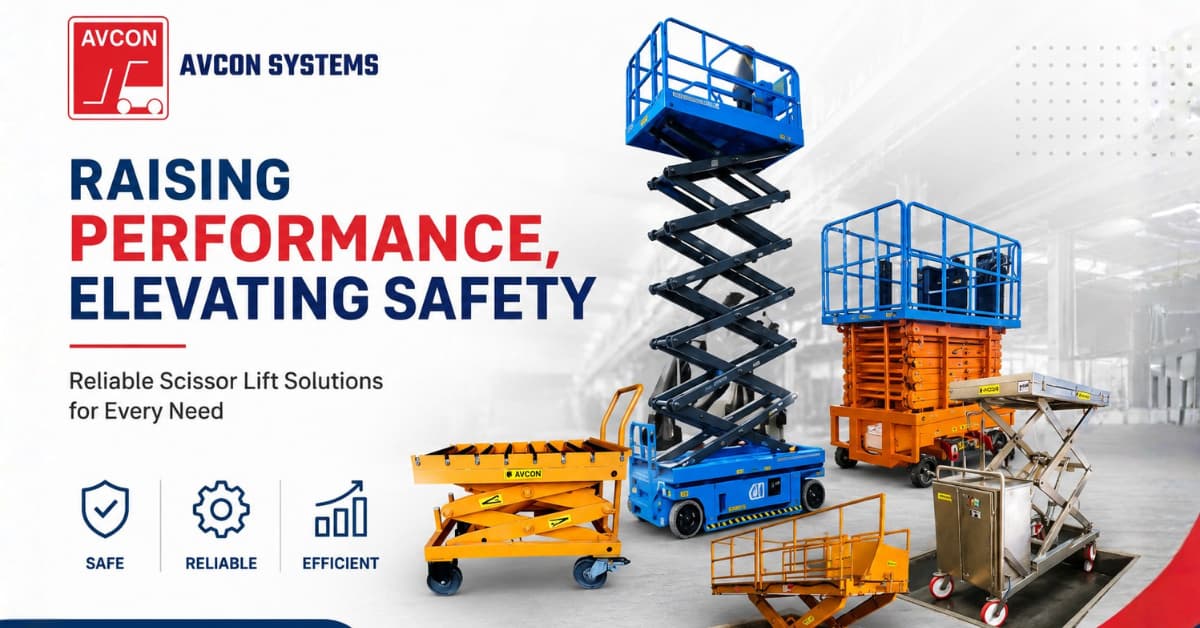
At Avcon, we build both standard catalogue models and full custom fabrication across mobile, outdoor, SS, and table variants. The right choice depends on whether a standard unit actually fits your application.
Scissor Lift Price Range in India — 2026 Reference
None of these figures includes GST, freight, or installation. Factor those in before you compare quotes side by side. If you’re based in Mumbai or Delhi, slightly higher logistics costs apply — demand and distance both affect what you pay on delivery.
| Type | Capacity | Estimated Price Range (INR) |
| Scissor Lift Table (Hydraulic) | 300 kg – 2 ton | ₹25,000 – ₹1,00,000 |
| Mobile Scissor Lift | 300 kg – 1 ton | ₹2,50,000 – ₹3,50,000 |
| Electric Scissor Lift | 300 kg – 1,000 kg | ₹4,00,000 – ₹10,00,000 |
| Compact / Indoor Scissor Lift | 500 kg – 1 ton | ₹3,00,000 – ₹7,00,000 |
| Towable Scissor Lift | 500 kg – 1.5 ton | ₹8,00,000 – ₹18,00,000 |
| Diesel / Rough Terrain Scissor Lift | 1 ton – 3 ton | ₹10,00,000 – ₹30,00,000+ |
Why Going Direct to a Manufacturer Saves Money
Every reseller in the chain adds their margin — that’s how distribution works, and there’s nothing unusual about it. When you buy direct from us, that layer isn’t there, and the price reflects it.
Price aside, there’s a practical difference in what you get post-sale. A dealer can deliver a machine. They can’t always get a technician to you quickly when something fails, they can’t always change a spec once an order is placed, and bulk pricing conversations hit a ceiling fast because their margins were set by someone else. Ours weren’t. That means real room to negotiate on volume orders, accessories, or AMC packages.
Avcon operates out of Thane with a turnover of ₹1.5–5 crore. We manufacture, we export, and when something needs sorting post-sale, you’re speaking directly to the people who built it.
How to Actually Get the Best Price
The lowest quote is rarely the best deal. Anyone who has bought industrial equipment before has figured this out at some cost.
Lock in your specs before you call anyone. Working height, load capacity, power type, indoor or outdoor application — have these confirmed before the first conversation. Walk in without that, and you’ll get a low number that doesn’t reflect what you actually need. The revisions come later, and they always cost more.
Check that quotes are built on identical specs. Two quotes for a “mobile scissor lift” — one at ₹2 lakh, one at ₹3.5 lakh — mean nothing if the specs underneath are different. Before you draw any conclusion from the gap, check that the capacity, height, and power type are the same across both quotes. If they’re not, you’re not comparing prices, you’re comparing products.
Work out the total cost of ownership. The purchase price is one number. Add AMC, spares, delivery, GST, and installation, and you get a different picture. A machine that costs less upfront but needs regular servicing will end up more expensive over five years than one that holds up without much attention.
Buying outside peak season gives you more room. Pre-monsoon and peak construction periods push demand up. Purchase outside those windows, and suppliers generally have more flexibility on price.
Financing is available if the upfront cost is a constraint. NBFCs like Bajaj Finserv cover equipment purchases. Worth looking into before you walk away from the right machine over a capital issue.