Walk into any large factory in India — a rolling mill, an automobile plant, a pharma packaging line — and the first thing you notice isn’t the machines. It’s the movement. Raw material coming in. Finished goods going out. Half-made products moving between stations. None of that happens on its own. Somebody designed the system that makes it happen. At Avcon Systems, that’s the business we’ve been in since 1984 — over four decades of building conveyor systems, EOT cranes, and bulk material handling solutions across steel, automotive, pharma, FMCG, and port sectors in India and beyond.
A 500 kg steel coil doesn’t walk itself from the rolling bay to the dispatch area. An e-commerce warehouse picking 80,000 orders before noon isn’t doing it by hand. In both cases, someone has thought carefully about how material moves — what carries it, what guides it, what slows it down safely at the other end. Do that thinking well and the plant runs. Do it poorly and the plant waits. Avcon Systems has spent more than four decades making sure Indian manufacturers get that thinking right.
What Is Material Handling Equipment?
Material handling equipment covers anything — a device, a machine, a full system — that moves material, keeps it stored safely, or controls where it goes. That’s true from the moment raw material arrives at your gate to the moment finished goods leave your loading bay.
The simplest hand pallet truck and a robotic palletising line stacking 2,000 cases an hour solve the same underlying problem: getting material from one place to another without relying on someone’s back to do it. Scale differs. Automation level differs. The core job doesn’t.
What Are the 4 Types of Material Handling?
Industry practitioners divide material handling into four categories. Knowing which one your challenge falls into helps you choose better solutions.
Storage and handling equipment — Pallet racking, mezzanine floors, silos, bins, and AS/RS systems. These hold your material when it’s not moving, and how well they do that directly affects how fast you can pick and how often you damage inventory just sitting there waiting its turn.
Engineered systems — Conveyor lines, sortation systems, AGVs, robotic palletisers. Built around a specific plant, a specific product, a specific daily volume. You can’t lift them from a catalogue. They have to be engineered around what you’re actually making and how fast you need to make it.
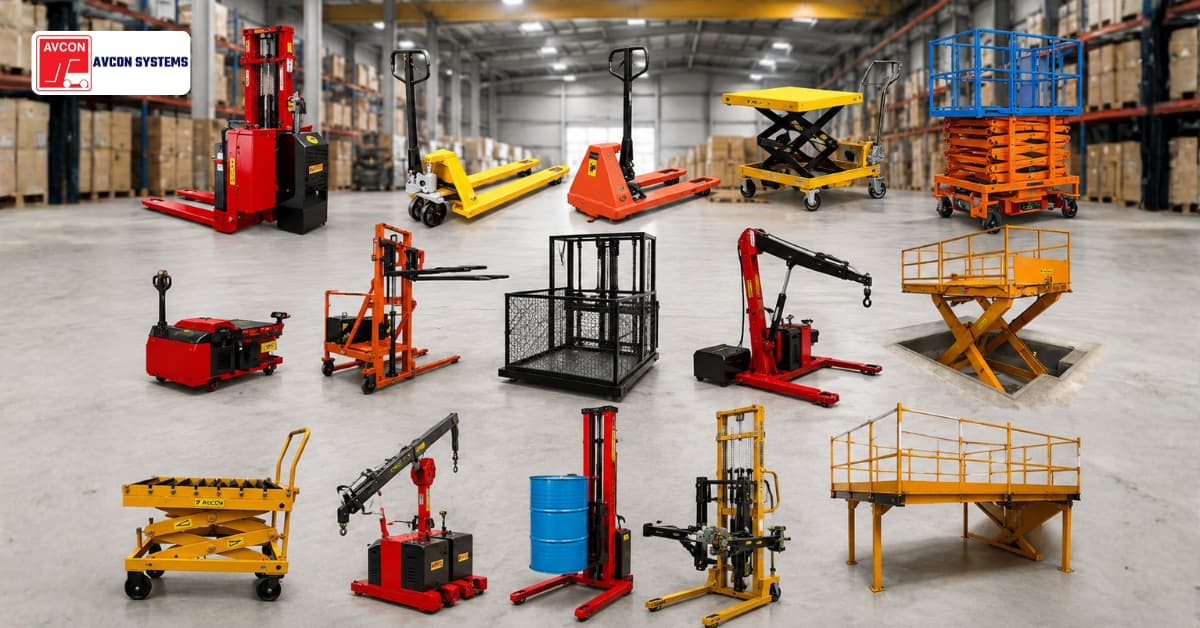
Industrial trucks — Forklifts, reach trucks, pallet stackers, tow tractors. Flexible and familiar. The honest trade-off: every one needs a trained operator, takes up floor space when parked, and moves at a pace that depends on whoever is behind the controls that shift.
Bulk material handling — Bucket elevators, screw conveyors, belt conveyors, hoppers, pneumatic conveying lines. Moving cement, coal, grain, or fertiliser puts different demands on equipment. The material wears things down, creates dust, and has to arrive at a consistent rate. Get any of those wrong, and the process downstream goes out of control.
Where Manufacturing Plants Actually Lose Money
Most plants think hard about their production process. Fewer think equally hard about what happens to material between production steps — and that gap is usually where the real bottlenecks live.
Poor material handling costs money in three specific ways, and most plants only see one of them clearly.
Production downtime is obvious. If the conveyor feeding a press line stops, the line stops. Two hours down on a line producing 400 units per hour is 800 units you will never recover.
Labour time is invisible. Plants rarely track how many man-hours per shift are spent simply carrying things. When someone measures it, the number is almost always higher than management expects.
Product damage is quiet. Material that’s manually handled more than necessary gets dropped, scraped, dented. In automotive or pharma, that damage often appears only after further processing — when it’s far more expensive to fix.
From Avcon Systems’ experience: Every project we take on starts with a material flow map — not a conversation about equipment types. Where does raw material enter? Where are the waits, the bottlenecks, the handoffs that slow everything down? That map tells us more than anything else, and it’s a discipline we’ve maintained across every sector we’ve worked in — from rolling mills in Maharashtra to pharmaceutical lines in Gujarat.
The Indian Market: Why This Industry Is Growing Fast
India’s material handling equipment market stood at $4.5–5 billion in 2023–24 and is projected to reach $8–10 billion by 2030 — a near-doubling in under a decade.
The growth is structural, not cyclical. GST consolidation pushed organised warehouse operators to invest in proper handling infrastructure. E-commerce volumes made manual picking at scale impossible. Government programmes — PM GatiShakti, the National Logistics Policy, dedicated freight corridors — created large-scale demand for heavy handling equipment. And automation adoption in automotive, FMCG, and pharma is accelerating, not because labour is disappearing, but because the consistency of automated handling cannot be matched manually once volumes cross certain thresholds.
Why Avcon Systems? Because Experience Changes the First Conversation
A conveyor system installed today, properly designed and maintained, will run for 15 to 25 years. A crane will serve a plant for decades. The decisions made at the design stage — component sizing, material selection, layout logic — shape how that equipment performs across its entire life.
Avcon Systems has been making those decisions since 1984. We’ve designed and installed material handling systems for steel plants in Jharkhand, automotive lines in Pune, pharma facilities in Ahmedabad, and port operations along India’s western coast. We’ve also exported to clients in Southeast Asia, the Middle East, and Africa — markets where Indian engineering capability and competitive pricing have opened a genuine door for manufacturers like us.
Forty-five years of project experience doesn’t make us infallible. But when a client brings us a challenge, there’s a very high probability we’ve seen something like it before — in a different industry, a different configuration, a different geography. That depth of reference improves the quality of the very first conversation, long before any steel is cut or any equipment is specified.
Conclusion
Material handling is not a support function. It is the circulatory system of a manufacturing plant — and when it fails, everything else stops with it. The right conveyor, the right crane, the right storage system, chosen and installed correctly, will run quietly and reliably for decades. The wrong one becomes a permanent bottleneck you spend years working around.
At Avcon Systems, we’ve spent more than four decades helping plant managers in India get this decision right — from the initial flow map to the final commissioning check. If your plant is growing, restructuring, or simply underperforming in ways that trace back to how material moves, that’s exactly the kind of conversation we’re built for.